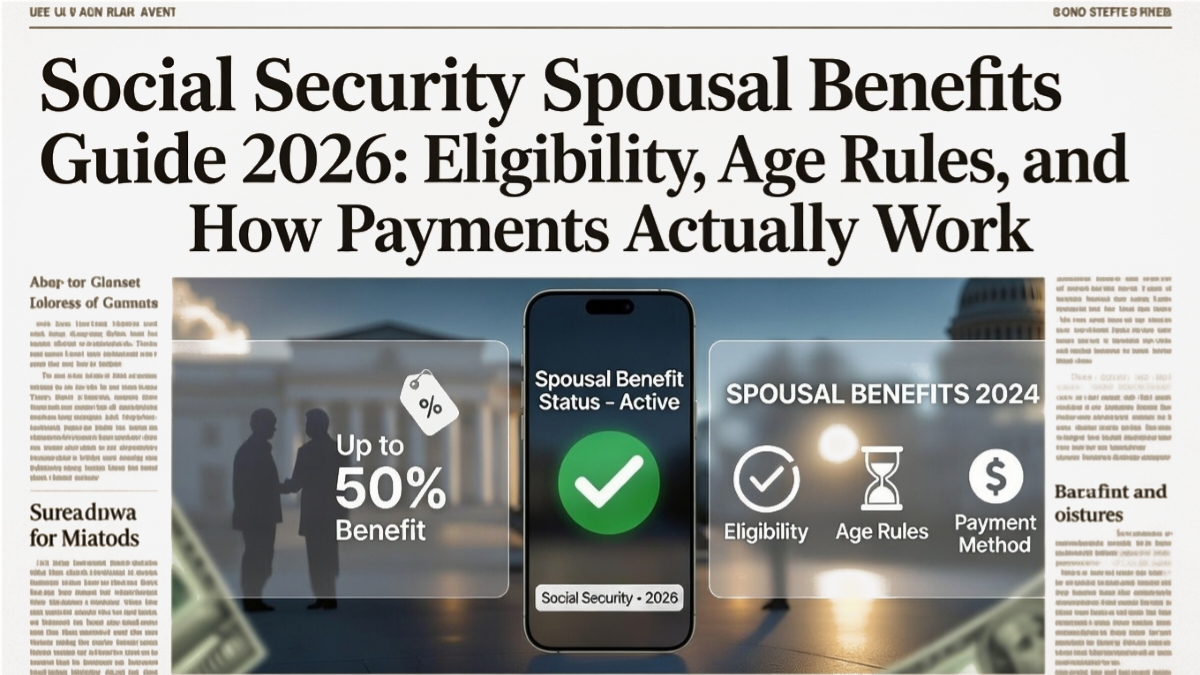
Social Security Spousal Benefits Guide 2026: Interest in Social Security spousal benefits has quietly surged as 2026 approaches, especially among older couples planning retirement amid rising living costs. Online forums, viral posts, and even some misleading videos have created confusion about whether spousal benefits are being expanded or reworked next year. In reality, nothing dramatic has changed. What has changed is the urgency with which families are trying to understand how these benefits fit into long-term financial planning.
Spousal benefits have existed for decades, designed to support married individuals who either earned less or stepped out of the workforce to manage family responsibilities. In 2026, the structure remains grounded in long-standing federal law, with only routine cost-of-living adjustments affecting monthly amounts. For couples nearing retirement, clarity matters more than ever. Knowing what has stayed the same and what has not can help avoid costly claiming mistakes that permanently reduce benefits.
No Rule Changes for Social Security Spousal Benefits in 2026
Despite persistent rumors, there are no legislative or administrative changes to Social Security spousal benefits scheduled for 2026. The Social Security Administration has not introduced new eligibility categories, bonus payments, or expanded percentages for spouses. What beneficiaries will see instead are standard annual cost-of-living adjustments, which apply across the board to all Social Security payments.
This stability reflects how firmly spousal benefits are embedded in federal law. Congress has debated broader Social Security reforms in recent years, particularly around long-term funding, but spousal benefit rules have largely remained untouched. For retirees, this means planning strategies that worked in 2024 or 2025 still apply in 2026. The absence of change is itself important news, especially amid widespread misinformation online.

Who Qualifies for Spousal Benefits Under Current Law
Eligibility for Social Security spousal benefits remains straightforward but strict. The applicant must be legally married to a worker who is entitled to Social Security retirement or disability benefits. In most cases, the marriage must have lasted at least one year before benefits can be claimed, though certain exceptions exist for parents of a worker’s child.
Crucially, the worker does not need to have claimed benefits for the spouse to be eligible, but the worker must be entitled to them. This distinction often trips people up. According to Mumbai-based retirement policy analyst Anil Deshmukh, “Many couples assume spousal benefits are automatic once one partner turns 62. In reality, entitlement and timing are everything, and misunderstanding that can delay payments or reduce them permanently.”

How Age and Timing Shape Spousal Benefit Payments
Age remains one of the most decisive factors in determining spousal benefit amounts. The earliest age to claim is 62, but doing so results in a permanent reduction. To receive the full spousal benefit capped at 50 percent of the worker’s Full Retirement Age (FRA) amount the spouse must wait until reaching their own FRA, which ranges between 66 and 67 depending on birth year.
Unlike individual retirement benefits, spousal benefits do not grow if claimed after FRA. Delayed retirement credits simply do not apply. This creates a different decision-making dynamic for couples. While higher-earning spouses may benefit from delaying their own claims, lower-earning spouses gain nothing by waiting beyond FRA for spousal benefits, a nuance often overlooked in casual retirement planning.
Spousal Benefits Versus Your Own Retirement Income
One persistent misconception is that Social Security pays both a personal retirement benefit and a spousal benefit simultaneously. In practice, beneficiaries receive only one payment the higher of the two. If someone qualifies for both, Social Security first pays the individual’s own benefit and then adds a spousal “top-up” only if the spousal amount is higher.
This coordination rule has major implications for working women and secondary earners, many of whom now have substantial earnings histories. Compared to earlier generations, more spouses today find their own retirement benefit exceeds the spousal benefit, making the latter irrelevant. “The system hasn’t caught up with social changes,” notes Deshmukh. “More dual-income households mean fewer people actually rely on spousal benefits alone.”
Working While Claiming Spousal Benefits
For those who claim spousal benefits before reaching Full Retirement Age and continue working, earnings limits still apply in 2026. If annual income exceeds the set threshold, Social Security temporarily withholds part of the benefit. This is not a penalty but a deferral; withheld amounts are recalculated after FRA.
Once Full Retirement Age is reached, these earnings limits disappear entirely. Benefits are no longer reduced, regardless of income. This rule is especially relevant as more retirees take up part-time or consulting work. With longer life expectancy and inflation pressures, combining work income with Social Security has become a common, and often necessary, strategy.
Why Spousal Benefits Still Matter in Retirement Planning
Even without changes for 2026, spousal benefits continue to play a vital role in retirement security. For couples with large income gaps, the benefit provides a predictable floor of income that adjusts annually for inflation. In uncertain economic conditions, that reliability carries real value.
Looking ahead, policy experts do not expect spousal benefits to expand, but neither are they likely to disappear. Any future Social Security reform would face intense political scrutiny. For now, the best approach remains informed timing and realistic expectations. As Deshmukh puts it, “The biggest risk isn’t policy change it’s misunderstanding the rules you already have.”
Public Confusion and the Cost of Misinformation
Social media has amplified confusion around Social Security spousal benefits, with exaggerated claims of “new bonuses” or “special 2026 increases” spreading rapidly. These narratives often target retirees anxious about inflation and healthcare costs, making them particularly persuasive.
The Social Security Administration has repeatedly clarified that spousal benefits follow established law, but official updates rarely travel as fast as viral misinformation. Financial planners advise retirees to rely on SSA statements or professional advice rather than online speculation. In retirement planning, a wrong assumption can mean thousands of dollars lost over a lifetime.
What Couples Should Watch Going Forward
While 2026 brings no structural changes, broader discussions about Social Security’s long-term funding continue in Washington. Any future reform could indirectly affect spousal benefits, especially if Full Retirement Age thresholds are adjusted decades down the line.
For now, couples are best served by understanding today’s rules and coordinating claims strategically. With longevity rising and retirement lasting longer, spousal benefits remain one piece of a much larger financial puzzle stable, familiar, and often misunderstood.
Disclaimer: This article is for informational and journalistic purposes only. It does not constitute financial, legal, or retirement advice. Social Security benefits, eligibility requirements, and payment rules are governed by federal law and official guidance issued by the Social Security Administration. Readers should consult official sources or qualified professionals before making benefit-related decisions.